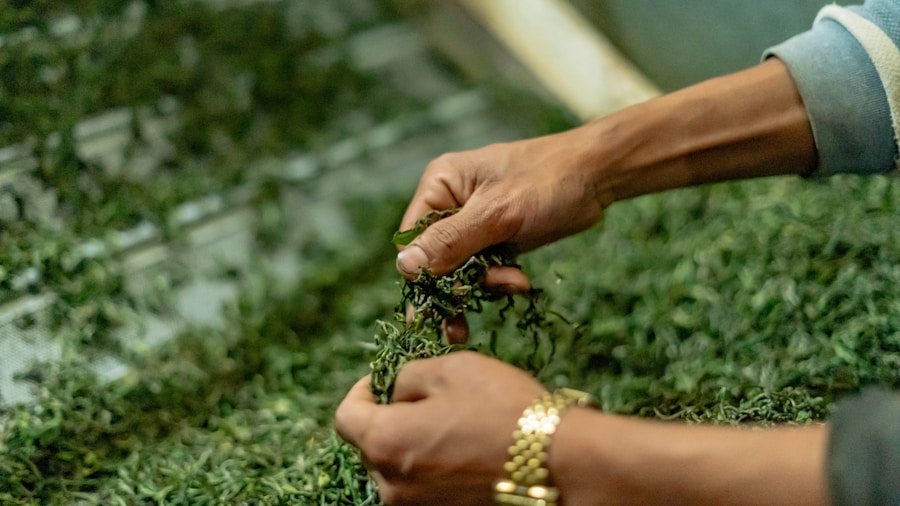
Buying tea at origin is different from buying tea at auction. Auction purchases are transactional — you bid on a lot you have typically cupped, but the relationship ends at the hammer price. Origin buying — establishing a direct relationship with a specific estate or garden — is longer, slower, and more demanding. It is also the only way to know, year after year, exactly what you are getting.
The sample tin protocol
Reputable gardens send sample tins before the main lot is offered. A standard sample tin in the Indian trade is 125–200 grams — enough for eight to ten proper cuppings. Our process begins the moment a sample arrives.
First: the visual inspection. Open the tin and look at the leaf before anything else. For a BP grade, you want uniform particle size and dark, glossy colour. Pale spots indicate uneven roasting or moisture exposure during storage. Broken irregularities that are too coarse or too fine relative to the stated grade indicate inconsistent processing. Visible stalk, fibre, or foreign matter indicates poor plucking standards.
Second: the dry aroma. Smell the dry leaf. For Assam BP, you expect malt, earth, and a clean woody note. For Darjeeling second flush, you look for the floral or honeyed register that indicates muscatel character in the dry state. A flat, papery, or chemically off aroma means storage problems. An overly sharp or fermented smell means processing errors.
Third: the standard brew. 2.5g per 150ml water, 95°C, four minutes, white ceramic cup. This is the consistent variable across every sample we evaluate. Every change to the protocol makes the comparison unreliable.
What the cup tells you
Colour and brightness: covered in detail in our liquor-reading piece. A dull, turbid, or greyed liquor is disqualifying at this stage.
First taste — body: how much does the liquor coat the palate? Thin body is a structural issue with the lot; it is not correctable by blending. A thin lot blended into a body-forward blend produces a diluted result.
Second taste — balance: where do the astringency and sweetness sit relative to each other? A well-processed Assam BP has astringency that is present but not aggressive — it adds structure without biting. Excessive astringency indicates over-fermentation during CTC processing. Flatness indicates under-fermentation.
Finish: how long does the character persist after swallowing? A high-quality lot stays present. A low-quality lot disappears within seconds.
The rejection threshold
At Aburaj, a sample is rejected without negotiation if:
- The dry leaf shows moisture damage (pale or clumped particles)
- The liquor is turbid or grey-toned
- Astringency dominates to the point that it overwhelms body
- The lot does not match the stated grade on visual inspection
A sample that passes these basic filters moves to blending trials — we test it against our benchmark blend to see if the new lot maintains the cup our customers know.
Why this process matters for a repacker
A repacker is not a grower. We do not control what happens in the field or on the processing floor. What we control is selection and blending. If we accept poor-quality raw material, no amount of careful packing and nitrogen flushing will produce the cup we intend. The sourcing decision is the quality decision.
This is why we work with a small number of growers rather than purchasing widely at auction. Three Assam gardens and one Darjeeling estate produce the leaf for all nine Aburaj SKUs. We know their harvest windows, their processing standards, and their off-years. We know when to wait and when to walk away.
The ISO 22000:2018 certification our facility carries documents this sourcing process — not just the packing line. The quality management system begins at the sample tin, not the sealing machine.